
Is Versable going to replace the catalog manager? My thoughts on the evolution of aftermarket cataloging
I've spent most of May on the road. Over the last few weeks, I've been bouncing between conferences and customer offices, talking to catalog managers, ecommerce teams, and executives about the state of the aftermarket. No matter where I go, the conversation eventually lands in the same place: AI.
It's been a useful month to step back. At my first ACPN two years ago, the general reaction to me and Versable was somewhere between polite skepticism and quiet fear.
It's astonishing how quickly sentiment has shifted. Today, it's difficult to attend an industry event where AI isn't one of the primary talking points. The conversation has evolved from whether AI matters to how quickly the industry will adapt to it.
Over the last two years, I've spent a lot of time thinking about what role Versable should play in that transition, and more broadly, where the aftermarket itself is headed. Here is where I've landed so far.
A job is a bundle of tasks, and the catalog manager's has already evolved many times
When people ask whether Versable is going to take their job, there's an assumption that the job is the most basal unit of what humans do at work. It isn't.
At its core, a job is nothing more than a bundle of tasks. This bundle changes over time, sometimes more dramatically than others, and a catalog manager's tasks have already changed many times.
Fifty years ago, cataloging literally meant managing physical catalogs. Teams were organizing printed materials, maintaining paper records, coordinating updates manually, and distributing information physically. Then the industry went through digitization, and the day-to-day work changed completely. Suddenly the focus became spreadsheets, databases, ACES/PIES files, ecommerce syndication, data standards, lookup systems, and endless formatting requirements across different channels.
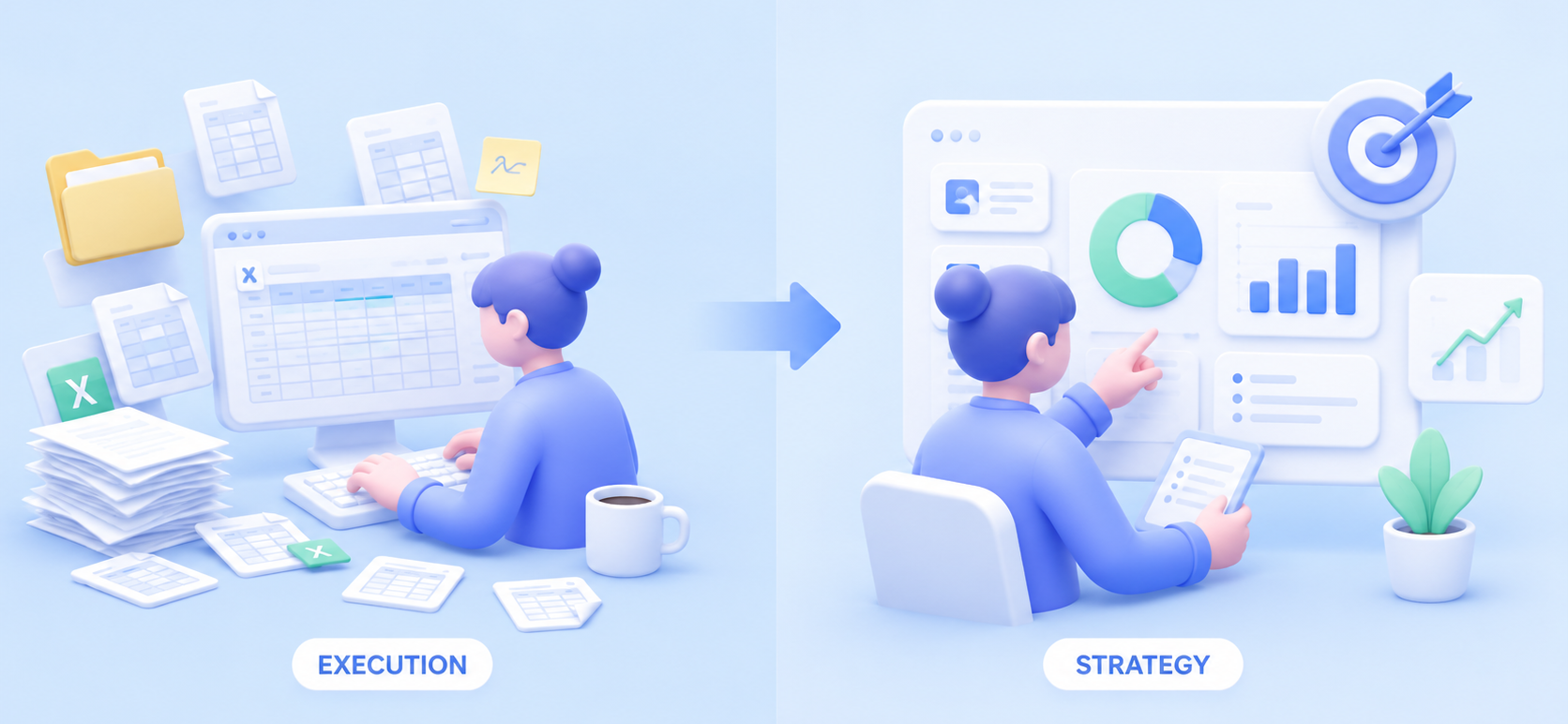
What stayed consistent through both eras, however, is that the catalog manager owned the execution layer, taking care of the work that needed to get done. These are not unimportant tasks. In many cases they are mission-critical. But they are highly structured and repetitive, which is exactly the kind of work that AI has gotten disproportionately good at doing.
This leaves something more important for the humans: the strategy layer.
The most valuable catalog managers I meet are almost never valuable because they can manually clean spreadsheets faster than everyone else. They're valuable because they deeply understand the business. They understand the product lines. They understand customer behavior, coverage gaps, competitive weaknesses, operational bottlenecks, channel requirements, and how all of those things connect together.
None of this need goes away with AI. If anything, it becomes more important, because for the first time in history, it stops being blocked by the unglamorous, time-consuming work of just keeping the catalog upright.
Being blocked on execution when the strategy is already figured out is one of the most expensive forms of waste in any business. Until recently, this was an unavoidable form of waste. It isn't anymore.
The biggest blocker to aftermarket evolution isn't technical progress, it's behavioral inertia
People assume that the hardest part about building Versable has been the technical work: architecting the AI platform, learning the syntax of complex aftermarket standards, or navigating deals with enterprise customers. These are real challenges, but by far easier than getting our daily user to change the way they've been working for years.
We designed Versable to be radically simple to use. We say internally that a 12 year old should be able to run it after a 30 minute onboarding. The product is fast, UI clean, and our workflows are simple. None of that, however, is enough on its own.
Over and over, we run into the same pattern: a customer signs, the team gets onboarded, they understand the platform, they agree it's much more efficient than their existing processes, then a few weeks later, go back to those exact processes.
This isn't a failing of our users. We are a creature of habit. We are extraordinarily prone to inertia, especially in the parts of our work and lives that feel mechanical, because those are the parts we've stopped critically thinking about.
I've found that the most effective way to overcome this is actually surprisingly human: 1:1 onboarding with each individual user, identifying a strong executive level champion inside the company, and showing up in person and sitting next to users while they work. None of this is particularly scalable, but it works now, and it will work for the foreseeable future. Ironically, for all the discussion around automation, I think the companies that will successfully navigate this transition, including Versable, are the ones that stay deeply human in how they implement it.
I bring this all up because I think the problem of behavioral inertia is the biggest bottleneck for the evolution of the aftermarket – and the biggest bottleneck to the evolution of the catalog manager job.
The bad news is that inertia at an industry scale is much, much harder to break than most people think. Industries don't change because a new tool exists. They change because enough people inside them decide to do things differently. This takes time, and there's no shortcut.
The good news is the opposite: on the scale of a single company, or a single team, or a single person, inertia is much easier to break. Industries move slowly until suddenly they don't, probably because competitive pressure forces the shift all at once.
At some point, one company becomes materially faster, leaner, and more efficient than everyone else. Then the rest of the market has no choice but to adapt.
So no, I don't think Versable is replacing the catalog manager. I think we're replacing a category of tasks that catalog managers have quietly accepted as unavoidable for a long time.
The people I met on this trip who have been most excited about what's to come are, interestingly, not the youngest people in the room. They're the industry veterans who lived through the first evolution of the aftermarket – the digitization of catalogs – and recognize the signs of the next big evolution. These are the teams that we're so excited to work alongside.
PS: welcome to our fifth blog post! I'm Christina - founder and CEO of Versable. If you're interested in getting started with Versable or want to learn more, feel free to shoot me an email at tina@versable.ai

