
Agentic commerce has a blind spot: it’s your data
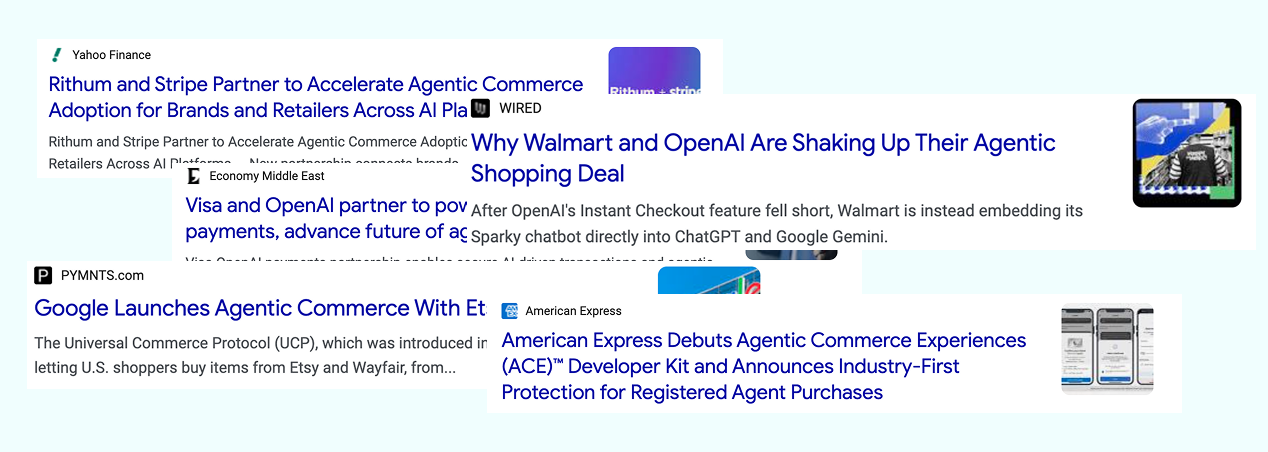
"Agentic commerce" is everywhere right now. Barely a week goes by without a new announcement — a payment network, a platform, a partnership — and lately I’ve received so many headlines from people in the industry asking some version of the same question: what is this and will this change things for us?
The latest one came from a customer who saw the Stripe x Rithum announcement on helping retailers “accelerate agentic commerce adoption” through their partnership.
As a founder building an AI tool, I’m genuinely excited to see all the adoption and intrigue. But the pace of this is genuinely dizzying even for me, and it’s hard to tell which new announcements are foundational and which ones are noise, let alone what any of this means if you sell something as hyper technical as auto parts.
So I want to lay out how I'm thinking about it: what agentic commerce really is, what all this infrastructure is quietly being built toward, and the one thing almost nobody is talking about that will decide who wins and who gets left behind, especially if you sell something as unforgiving as auto parts.
What does agentic ecommerce even mean?
First it's worth being clear about the word "agent," because it's doing a lot of work and it isn't the same thing as the AI most people have gotten used to. The AI you've been using for the last couple of years, asking ChatGPT questions, is fundamentally a responder. You ask, it answers, and then it stops.
What's new now is that the agent is being trusted to act: to pick the item and put it in the cart without a human looking at it first.
An agent is AI that's been given the ability to take actions in the world, not just produce text about them. Instead of telling you which part you should buy, it can go find the part, compare options across sites, add it to a cart, and complete the purchase. It can use tools, browse, fill out forms, and chain several steps together to accomplish a goal you handed it.
This distinction is the foundation of agentic commerce.
For thirty years, online shopping has been a person looking at a screen. You read a search results page, you compare options, you click buy. Agentic commerce moves that decision into a conversation and, crucially, hands part of it to the agent. You tell an AI assistant what you need, and it searches, evaluates, and increasingly transacts on your behalf. You don't browse the results; the agent browses them for you and comes back with the answer, or just buys the thing.
The Stripe x Rithum announcement and many, many more
Let’s take a look at the Stripe x Rithum announcement that most recently landed in my inbox.
Rithum already manages catalog data for tens of thousands of brands and retailers. Stripe (a payment processor that we also use at Versable) launched its Agentic Commerce Suite in December. Together, they're offering some Rithum clients a way to syndicate their catalog into AI agents and accept payment inside the conversation.
But they're far from alone. The payment networks have all moved: Visa with Intelligent Commerce and its Trusted Agent Protocol, Mastercard with Agent Pay and its Agentic Tokens, American Express with a developer kit and even purchase protection for agent-made purchases. Amazon's Rufus is reportedly serving hundreds of millions of users.
Every one of these systems is built to move product data from one place to another and close a transaction around it. Not one of them asks whether that product data is any good. They will faithfully carry a wrong fitment, a missing spec, or a mislabeled part straight to the agent, and the agent will act on it with total confidence. We are building a beautiful, high-speed delivery system for product data and quietly assuming the data we're pouring into it is correct.
It often isn't.
An agent reasoning over bad data is just a faster way of being wrong
Here's something we don't usually say out loud about ecommerce: the shopper has always been the last line of defense against bad product data.
Think about how this works today. A customer is looking for something. The listing might have a vague title, a missing attribute, or a spec that's slightly off. But the human catches it. They look at the photo. They read the reviews. They notice something doesn't add up, and they hesitate, or they bail at checkout. The catalog can be imperfect because a person is silently correcting for it at the very last step.
An agent does none of this. It takes your catalog at face value and acts on it. If your data says something is true, the agent doesn't second-guess it, and it buys accordingly.
So as we take the human out of the loop, the entire burden of correctness shifts upstream onto the data itself. The errors that used to get caught by human judgment at the moment of purchase now have to be caught before the data ever reaches the agent, because there's no longer anyone standing between a wrong recommendation and a completed transaction.
This is the biggest blocker for agentic commerce. And all that infrastructure being built so beautifully right now quietly assumes the data flowing through it is already correct.
Why this is so much harder for auto parts
If you sell paper towels, none of this is a crisis. A slightly wrong recommendation is a minor annoyance, the customer shrugs, and life goes on.
The aftermarket is the opposite end of that spectrum, and it's worth being honest about why.
Our data is hard. Fitment and attributes are not just nice-to-haves; it's the entire purchase. Parts data arrives from hundreds of manufacturers in inconsistent formats, riddled with gaps and conflicts, mapped against standards like ACES and PIES that most of the world has never heard of. We've spent years building Versable precisely because this data is so painful to get right at scale.
Now put that data behind an agent. A customer asks an assistant for a part for their truck. The agent reads your product data, takes it at face value, recommends a part, and buys it. If that fitment is wrong, there is no human in the loop to catch it. And there are no error messages when this happens. It's a confidently wrong recommendation, a completed purchase, a return, a frustrated customer, and a quiet erosion of trust in the whole channel.
In the aftermarket, "the payment connection worked" and "the customer got the right part" are completely different statements. The rails guarantee the first. Only your data quality guarantees the second.
Walmart x Open AI: we already watched this fail at the largest possible scale
If this sounds theoretical, it isn't.
Last October, Walmart and OpenAI launched the most visible version of agentic commerce there has been: buy Walmart products directly inside ChatGPT.
Five months later, Walmart pulled it. The reasons that surfaced were not about the connection. They were about the data: wrong items showing up in carts, accuracy problems, conversion well below Walmart's own channels. Walmart has since shifted toward putting its own assistant inside ChatGPT and Gemini, keeping control of its data and customer relationship.
What you actually need to get to agentic commerce
So here's where I've landed.
The wave is real, and I don't think anyone in the aftermarket should sit it out. The rails are being built fast, by serious companies, and they'll mostly work. The pipes are becoming a commodity. Connecting to them will not be your competitive advantage, because everyone will be connected to them.
What you actually need to win agentic commerce is upstream of all of it: product data clean, complete, and structured well enough that an agent can be trusted to act on it without a human double-checking the result. Correct fitment. Complete attributes. Consistent formatting across every standard and channel.
The boring, unglamorous foundation that has always mattered and is about to matter enormously more, because for the first time the data is being handed straight to something that will act on it and cannot tell when it's wrong.
That's not a plumbing problem. It's a data problem. And in the hardest categories — deep catalogs, complex fitment, messy multi-vendor data — it's an existential one.
This is exactly the problem we built Versable to solve: taking the messy, inconsistent, incomplete catalog data the aftermarket runs on and making it correct, complete, and ready to be acted on at scale. A year ago that was a story about getting to market faster and onboarding brands without a backlog. It still is. But it's quickly becoming something bigger: the difference between being ready for agentic commerce and being one wrong recommendation away from losing a customer's trust in it.
The rails are coming whether we're ready or not. The work now is making sure the data flowing through them is worth trusting.
PS: welcome to our sixth blog post! I'm Christina - founder and CEO of Versable. We spend our days making messy aftermarket catalogs correct enough to be trusted, which is starting to matter in ways it didn't a year ago. If you're thinking through what agentic commerce means for your catalog, shoot me an email at tina@versable.ai

